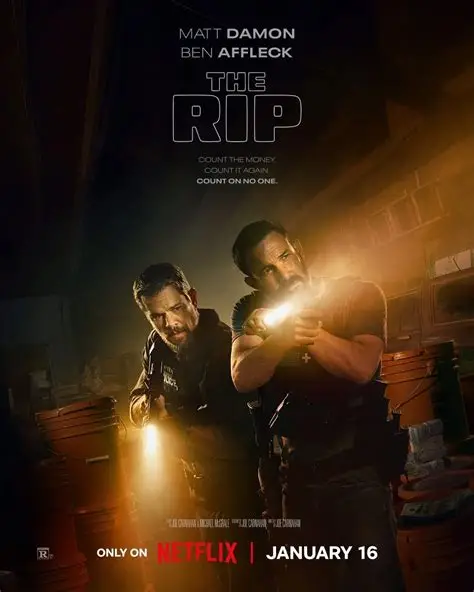
Standing Among Crime Film Tradition
The Rip does not try to compete with loud crime classics. It does not aim to be Heat, Training Day, or Scarface. Instead, it positions itself closer to a quieter tradition of crime cinema—films that focus on process, pressure, and personal collapse rather than spectacle.
Its ambition is modest, but deliberate.
Where many crime films ask how far criminals will go, The Rip asks a harder question:
How far will ordinary men drift before they no longer recognize themselves?
This approach gives the film its identity.
Comparison with Classic Crime Films
Compared to Heat (1995)
Heat is about obsession and professional pride. Its characters are defined by scale and precision.
The Rip is smaller, tighter, and more personal.
Where Heat stages large confrontations, The Rip stages private confrontations—in cars, offices, and quiet rooms. The tension does not come from firepower, but from hesitation.
Both films respect realism, but The Rip removes the myth of greatness. Its characters are not legends. They are men trying to survive pressure.

Compared to Training Day (2001)
Training Day is loud, aggressive, and explosive. Corruption is obvious and dramatic.
The Rip takes the opposite path.
Corruption in The Rip is not announced. It creeps in slowly. There is no shocking moment where a character becomes “bad.” Instead, small compromises stack on top of each other.
This makes The Rip less shocking, but more believable.
Compared to End of Watch (2012)
Both films value authenticity and partnership. But while End of Watch emphasizes brotherhood under danger, The Rip explores brotherhood under temptation.
The threat is not external violence. The threat is choice.

A Film About Systems, Not Villains
One of the most mature elements of The Rip is its refusal to create a clear villain.
There is no mastermind pulling strings.
There is no evil figure manipulating events.
Instead, the system itself becomes the pressure point.
Low pay. Long hours. Emotional fatigue. Lack of trust in institutions.
The film suggests that corruption does not grow because people are weak—but because systems are unforgiving.
This idea makes The Rip uncomfortable in a meaningful way. It does not allow the audience to blame one person and move on.
Real Consequences Without Moral Lectures
The Rip never lectures the audience.
There are no speeches explaining morality. There are no scenes designed to force sympathy.
Instead, the film lets consequences speak.
Relationships cool. Trust dissolves. Small lies expand into permanent damage.
By the time consequences arrive, they feel inevitable—not dramatic.
This restraint shows confidence in storytelling.

The Ending: Quiet, Honest, and Divisive
The film’s ending has divided viewers.
Some expected tragedy. Others expected redemption.
What The Rip delivers instead is resolution without relief.
The final moments suggest that life continues—but nothing returns to how it was before.
This ending fits the film’s tone. It reflects reality more than cinematic fantasy.
Not every story ends with justice or collapse. Some end with damage that must be carried forward.
This choice may disappoint viewers looking for emotional release, but it strengthens the film’s integrity.

Long-Term Impact and Rewatch Value
The Rip is not designed to impress on first viewing alone.
Its strength lies in subtle detail:
-
A look held too long
-
A sentence left unfinished
-
A pause before a decision
These moments gain weight on rewatch.
Viewers who revisit the film often notice how early the cracks appear. How small signals were present long before open conflict.
This gives The Rip lasting value beyond its initial release.

Strengths That Define the Film
-
Grounded performances built on restraint
-
Authentic atmosphere that avoids glamour
-
Moral complexity without forced judgment
-
Disciplined direction that prioritizes story over style
These strengths may not generate loud praise, but they build trust with the audience.
Limitations That Hold It Back
-
The film avoids major risks in its final act
-
Some secondary characters feel incomplete
-
The story stays within safe genre boundaries
These limits prevent The Rip from becoming iconic—but they also prevent it from becoming careless.
Final Evaluation
The Rip succeeds not by ambition, but by control.
It knows its limits.
It respects realism.
It trusts the audience to think.
In a genre often defined by excess, that restraint feels refreshing.
Final Ratings
-
Writing & Structure: ★★★★☆
-
Performances: ★★★★☆
-
Atmosphere & Realism: ★★★★☆
-
Originality: ★★★☆☆
-
Overall Impact: ★★★★☆
Final Conclusion
The Rip (2026) is a crime film about erosion.
Not the collapse of cities.
Not the fall of empires.
But the slow erosion of trust, belief, and certainty.
It reminds us that the most dangerous crimes do not always involve guns or speed. Sometimes they happen quietly—between people who once trusted each other completely.
That quiet truth is what gives The Rip its power.